Author Study

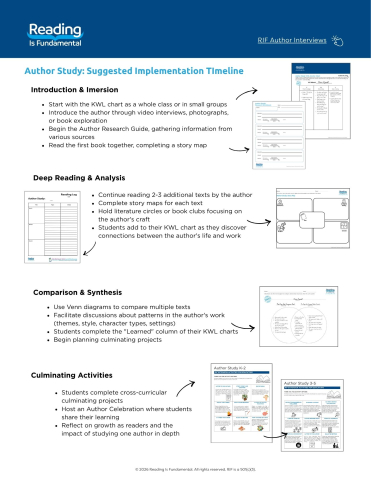
Dive deep into an author's world with RIF's Author Study, a complete K–5 literacy unit that guides students through reading, research, and cross-curricular exploration of a single author's body of work. Packed with educator planning sheets, student worksheets, story maps, KWL charts, Venn diagrams, and differentiated Think-Tac-Toe extension activities for both K–2 and 3–5 learners, this resource makes it easy to build reading fluency, critical thinking, and a lifelong love of books. Which author will your class discover next?

Resource Information

Age Range
5 - 10
Grade Level
K - 5th
Literacy Standards
CCSS.ELA-LITERACY.CCRA.R.1
Anchor Standards for Reading: Key Ideas and Details: Read closely to determine what the text says explicitly and to make logical inferences from it; cite specific textual evidence when writing or speaking to support conclusions drawn from the text.
CCSS.ELA-LITERACY.RL.K.1
With prompting and support, ask and answer questions about key details in a text.
CCSS.ELA-LITERACY.RL.1.1
Ask and answer questions about key details in a text.
CCSS.ELA-LITERACY.RL.2.1
Ask and answer such questions as who, what, where, when, why, and how to demonstrate understanding of key details in a text.
CCSS.ELA-LITERACY.RL.3.1
Ask and answer questions to demonstrate understanding of a text, referring explicitly to the text as the basis for the answers.
CCSS.ELA-LITERACY.RL.4.1
Refer to details and examples in a text when explaining what the text says explicitly and when drawing inferences from the text.
CCSS.ELA-LITERACY.RL.5.1
Quote accurately from a text when explaining what the text says explicitly and when drawing inferences from the text.
CCSS.ELA-LITERACY.CCRA.R.2
Anchor Standards for Reading: Key Ideas and Details: Determine central ideas or themes of a text and analyze their development; summarize the key supporting details and ideas.
CCSS.ELA-LITERACY.RL.K.2
With prompting and support, retell familiar stories, including key details.
CCSS.ELA-LITERACY.RL.1.2
Retell stories, including key details, and demonstrate understanding of their central message or lesson.
CCSS.ELA-LITERACY.RL.2.2
Recount stories, including fables and folktales from diverse cultures, and determine their central message, lesson, or moral.
CCSS.ELA-LITERACY.RL.3.2
Recount stories, including fables, folktales, and myths from diverse cultures; determine the central message, lesson, or moral and explain how it is conveyed through key details in the text.
CCSS.ELA-LITERACY.RL.4.2
Determine a theme of a story, drama, or poem from details in the text; summarize the text.
CCSS.ELA-LITERACY.RL.5.2
Determine a theme of a story, drama, or poem from details in the text, including how characters in a story or drama respond to challenges or how the speaker in a poem reflects upon a topic; summarize the text.
CCSS.ELA-LITERACY.CCRA.R.3
Anchor Standards for Reading: Key Ideas and Details: Analyze how and why individuals, events, or ideas develop and interact over the course of a text.
CCSS.ELA-LITERACY.RL.K.3
With prompting and support, identify characters, settings, and major events in a story.
CCSS.ELA-LITERACY.RL.1.3
Describe characters, settings, and major events in a story, using key details.
CCSS.ELA-LITERACY.RL.2.3
Describe how characters in a story respond to major events and challenges.
CCSS.ELA-LITERACY.RL.3.3
Describe characters in a story (e.g., their traits, motivations, or feelings) and explain how their actions contribute to the sequence of events.
CCSS.ELA-LITERACY.RL.4.3
Describe in depth a character, setting, or event in a story or drama, drawing on specific details in the text (e.g., a character's thoughts, words, or actions).
CCSS.ELA-LITERACY.RL.5.3
Compare and contrast two or more characters, settings, or events in a story or drama, drawing on specific details in the text (e.g., how characters interact).
CCSS.ELA-LITERACY.CCRA.R.4
Anchor Standards for Reading: Craft and Structure: Interpret words and phrases as they are used in a text, including determining technical, connotative, and figurative meanings, and analyze how specific word choices shape meaning or tone.
CCSS.ELA-LITERACY.RL.K.4
Ask and answer questions about unknown words in a text.
CCSS.ELA-LITERACY.RL.1.4
Identify words and phrases in stories or poems that suggest feelings or appeal to the senses.
CCSS.ELA-LITERACY.RL.2.4
Describe how words and phrases (e.g., regular beats, alliteration, rhymes, repeated lines) supply rhythm and meaning in a story, poem, or song.
CCSS.ELA-LITERACY.RL.3.4
Determine the meaning of words and phrases as they are used in a text, distinguishing literal from nonliteral language.
CCSS.ELA-LITERACY.RL.4.4

Determine the meaning of words and phrases as they are used in a text, including those that allude to significant characters found in mythology (e.g., Herculean).

CCSS.ELA-LITERACY.RL.5.4
Determine the meaning of words and phrases as they are used in a text, including figurative language such as metaphors and similes.
CCSS.ELA-LITERACY.CCRA.R.5
Anchor Standards for Reading: Craft and Structure: Analyze the structure of texts, including how specific sentences, paragraphs, and larger portions of the text (e.g., a section, chapter, scene, or stanza) relate to each other and the whole.
CCSS.ELA-LITERACY.RL.K.5
Recognize common types of texts (e.g., storybooks, poems).
CCSS.ELA-LITERACY.RL.1.5
Explain major differences between books that tell stories and books that give information, drawing on a wide reading of a range of text types.
CCSS.ELA-LITERACY.RL.2.5
Describe the overall structure of a story, including describing how the beginning introduces the story and the ending concludes the action.
CCSS.ELA-LITERACY.RL.3.5
Refer to parts of stories, dramas, and poems when writing or speaking about a text, using terms such as chapter, scene, and stanza; describe how each successive part builds on earlier sections.
CCSS.ELA-LITERACY.RL.4.5
Explain major differences between poems, drama, and prose, and refer to the structural elements of poems (e.g., verse, rhythm, meter) and drama (e.g., casts of characters, settings, descriptions, dialogue, stage directions) when writing or speaking about a text.
CCSS.ELA-LITERACY.RL.5.5
Explain how a series of chapters, scenes, or stanzas fits together to provide the overall structure of a particular story, drama, or poem.
CCSS.ELA-LITERACY.CCRA.R.6
Anchor Standards for Reading: Craft and Structure: Assess how point of view or purpose shapes the content and style of a text.
CCSS.ELA-LITERACY.RL.K.6
With prompting and support, name the author and illustrator of a story and define the role of each in telling the story.
CCSS.ELA-LITERACY.RL.1.6
Identify who is telling the story at various points in a text.
CCSS.ELA-LITERACY.RL.2.6
Acknowledge differences in the points of view of characters, including by speaking in a different voice for each character when reading dialogue aloud.
CCSS.ELA-LITERACY.RL.3.6
Distinguish their own point of view from that of the narrator or those of the characters.
CCSS.ELA-LITERACY.RL.4.6
Compare and contrast the point of view from which different stories are narrated, including the difference between first- and third-person narrations.
CCSS.ELA-LITERACY.RL.5.6
Describe how a narrator's or speaker's point of view influences how events are described.

CCSS.ELA-LITERACY.CCRA.R.1
Anchor Standards for Reading: Integration of Knowledge and Ideas: Integrate and evaluate content presented in diverse media and formats, including visually and quantitatively, as well as in words.

CCSS.ELA-LITERACY.RL.K.7
With prompting and support, describe the relationship between illustrations and the story in which they appear (e.g., what moment in a story an illustration depicts).
CCSS.ELA-LITERACY.RL.1.7
Use illustrations and details in a story to describe its characters, setting, or events.
CCSS.ELA-LITERACY.RL.2.7
Use information gained from the illustrations and words in a print or digital text to demonstrate understanding of its characters, setting, or plot.
CCSS.ELA-LITERACY.RL.3.7
Explain how specific aspects of a text's illustrations contribute to what is conveyed by the words in a story (e.g., create mood, emphasize aspects of a character or setting).
CCSS.ELA-LITERACY.RL.4.7
Make connections between the text of a story or drama and a visual or oral presentation of the text, identifying where each version reflects specific descriptions and directions in the text.
CCSS.ELA-LITERACY.RL.5.7
Analyze how visual and multimedia elements contribute to the meaning, tone, or beauty of a text (e.g., graphic novel, multimedia presentation of fiction, folktale, myth, poem).