From Reading to Performance: Reimagining Literacy with Life Histories
Rowan University literacy professors Valarie Lee, Susan Browne, and Marjorie Madden recently partnered with Reading Is Fundamental (RIF) for the webinar Every Book is a Life Histories Book, where they shared an innovative approach to helping students connect more deeply with texts. In this guest blog, the authors explore how “Life Histories” encourages students to move beyond traditional reading assignments through discussion, writing, collaboration, and performance. Readers will learn how this framework supports critical literacy, student engagement, and joyful learning while helping young people see themselves and others reflected in literature. The approach aligns closely with RIF’s mission to create meaningful, inclusive literacy experiences that inspire all children to read and learn.
Reimagining Literacy Through Life Histories
In a recent Reading is Fundamental (RIF) webinar, Every Book is a Life Histories Book, we introduced an innovative approach to engaging readers in deeper interpretation of texts. We shared the process of Life Histories, provided classroom examples of Life Histories in action, and suggested ways that teachers might engage in Life Histories' work. This approach aligns with and supports RIF’s commitment to helping students see themselves and their worlds reflected in meaningful literacy experiences. In the following blog post, we further describe Life Histories and its possibilities for engaging students more deeply and critically in texts.
Today’s students navigate the rapid pace of texting, Instagramming, TikToking, Facebooking, tweeting, and new, constantly evolving technology. Digital language has become a common discourse making it increasingly important for classrooms to engage readers with text. The role of teachers often involves convincing students that reading books can move to new and deeper levels of understanding ... of ourselves and of others. So many of our students simply do not want to read in traditional ways. English reading and writing assignments are often dismissed as “work to be done” but work with little value or connection to their lives. So how do we counteract these responses to school? How do we convince students that reading, talking and thinking about books can ultimately lead to deeper understandings of the world and their place in it? Life Histories might be one way to bring youth back to reading and the power of the printed word.
The practice of reading literature slows thought down … a book provides a rare opportunity for sustained focus, contemplation, and introspection.
What Are Life Histories?
Life Histories begin with the selection of a diverse/critical text that offers rich character portrayals and narratives that address important issues and themes central to critical literacy such as identity, power, justice and representation, and the students’ lives. In our work, we have introduced educators and students to critical texts from 5th-12th grades: picture books such as The Undefeated, elementary novels such as Daniel’s Story and adolescent novels such as Seedfolks, All American Boys, Long Way Down, and The Skin I’m In. We know that multicultural texts invite readers in; Rudine Sims-Bishop’s windows and mirrors vision underscores every book we propose.
The RISP Framework for Critical Literacy
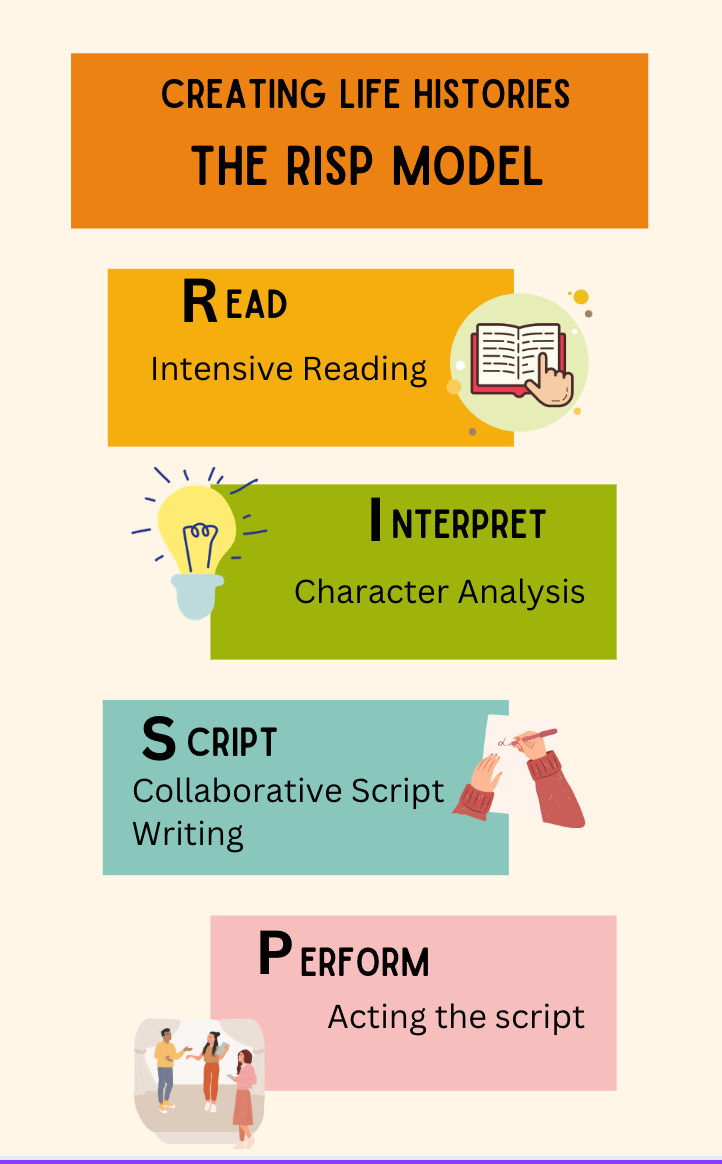
We’ve named it RISP which represents the process and stages that readers go through when creating Life Histories:
1. Read (Intensive/Critical Reading)[Text Wrapping Break]Select a meaningful text and read it closely. Question the author’s purpose, perspectives, and what is included or missing while identifying key characters and themes.
2. Interpret (Character Analysis)[Text Wrapping Break]Reread and analyze a chosen character in depth. Use evidence, discussion, and personal connections to understand their motivations, identity, and role in the story.
3. Script (Collaborative Writing)[Text Wrapping Break]Work in groups to create a script that gives voice to the character. Use textual evidence and creativity to build a deeper, more complex portrayal.
4. Perform (Dramatic Representation)[Text Wrapping Break]Bring the script to life through performance, often as a spoken word poem or dramatic monologue. Focus on actions, emotions, and interpretation to fully embody the character and communicate meaning.
We believe that literary Life Histories offer opportunities for readers to fully interact with texts through talk, writing and performing. We are also always mindful of how Life Histories can become a strong catalyst to evoke emotion, compassionate understanding and acknowledgement of difference and its challenges.
Bringing Joy Back to Reading
To give you an idea of the breadth of our work, we’ve traveled across the United States and internationally in places as diverse as Oxford, Ireland, Greece and Guatemala. Our book, Literary Life Histories, Reclaiming Reading and Living the Story, (publication this spring, 2026) provides classroom stories, pedagogical strategies as well as current, multicultural texts that might be useful to teachers and educators willing to engage in the Life Histories process. It’s been an amazing adventure to work with so many different students and teachers, all who have validated our belief in the power of literary Life Histories to push readers to deeper understandings of self and other. And have fun in the doing! Gholdy Muhammad (2023) argues that we must bring back the joy in learning and we agree. It’s been our experience that Life Histories does indeed bring back the joy of reading!
“I really didn’t know what to expect; but the performances at the end were really powerful. Life histories changed the organic nature of my classroom. My kids changed the rules. They moved outside the constraints of group work to interact across characters, giving a deeper understanding of the book and the work.” (Ms. D. 8th Grade Teacher)
“I got to perform, and I loved it!” (Denae); “I like that we acted like the people from the story” (Keyon)
“I liked that we performed, and I loved it!” (Malika).
-Middle School Students at Bushfire Theatre, Philadelphia
References:
Alexander, K. and Nelson, K. The Undefeated: A Powerful poem celebrating strength and Black excellence for children. Verisfy.
Flake, S. (1998). The skin I’m in. Jump at the Sun/Hyperion Books.
Fleischman, P. (2004). Seedfolks. Harper Trophy.
Matas, C. (1993). Daniel’s story. Scholastic.
Muhammad, G. (2023). Unearthing joy: A guide to culturally and historically responsive curriculum and instruction. New York: Scholastic Professional.
Reynolds, J. (2017). Long way down. Atheneum.
Sims-Bishop, R. (1990). “Mirrors, Windows and Sliding Glass Doors. Perspectives: On Choosing and Using Books for the Classroom, 6(3).
Biographies:
Valarie Lee is Associate Professor of Literacy in the Department of Critical Literacy, Technology, and Multilingual Education at Rowan University, USA. With 28 years in high school and university teaching, Valarie researches adolescent literacy and lesson study. She is a co-founder of The Literacy Consortium and the Rowan University Writing Project. She serves on the RIF Early Childhood Advisory Board. Connect with her at leev@rowan.edu
Susan Browne is Professor of Literacy in the Department of Critical Literacy, Technology, and Multilingual Education at Rowan University, USA. Susan teaches reading courses and advises graduate thesis research. A former Philadelphia teacher, she researches critical pedagogies, urban education, and diverse youth literature. She co-founded the Rowan University Writing Project. She serves on the RIF Middle School Family Literacy Initiative Advisory Board. Connect with her at brownes@rowan.edu
Marjorie Madden is Associate Professor of Literacy in the Department of Critical Literacy, Technology, and Multilingual Education at Rowan University, USA. With over 40 years of experience in education, Marjories’s researches underserved students, inclusive literacy practices, and critical pedagogy. She co-founded The Literacy Consortium and the Rowan University Writing Project. She serves on the RIF Early Childhood Advisory Board. Connect with her at madden@rowan.edu
Get Inspired—Read RIF's Blog
Stay connected with the heart of our mission by exploring our blog. We feature stories from communities we serve, literacy tips for educators and families, and updates on how Reading Is Fundamental is helping children across the nation discover the joy of reading.